Bachelor of Arts (Social and Religious Studies)
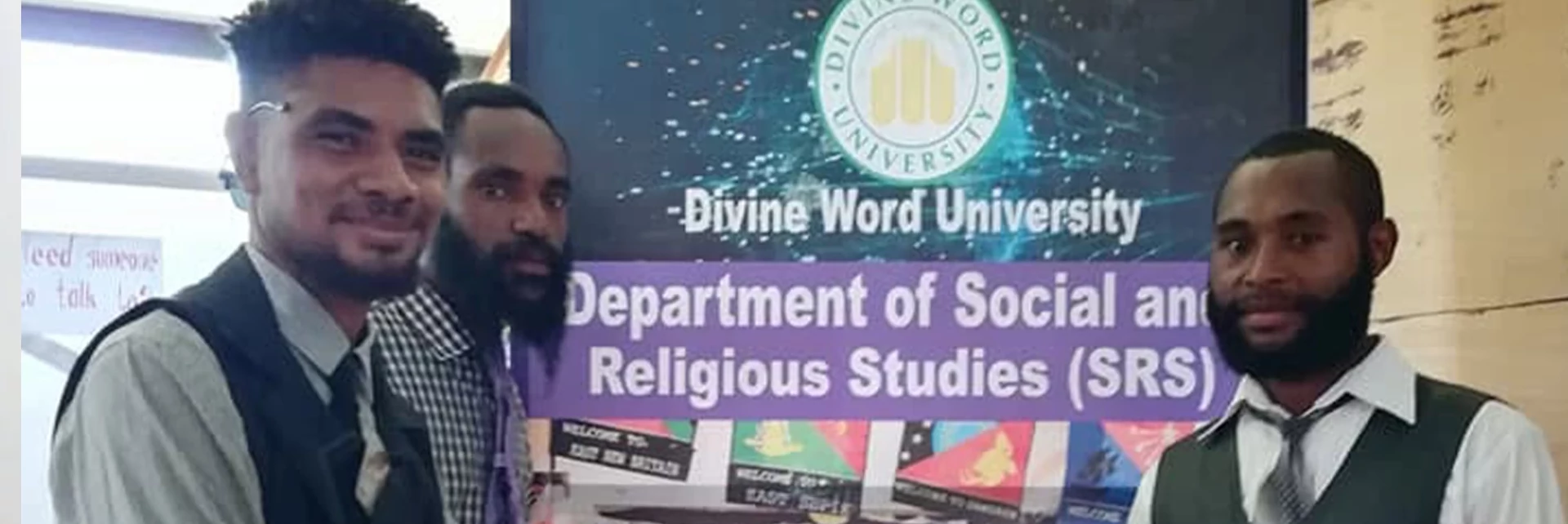
The program focuses on the education of personal development, social welfare, counselling skills in the context of social and pastoral ministry, religious and pastoral aspects of students at undergraduate level so that they can be holistically grounded to contribute effectively to the improvement of social, spiritual and pastoral aspects and wellbeing of populations in Papua New Guinea (PNG). The department offers a four-year program, Bachelor of Arts (SRS). The program comprises three strands, namely, personal development, social welfare, and pastoral and religious ministry. Various units are assigned under each strand.
-
IS117 End User Computing and Word Processing
Study Period: Semester OneTechnology, computers and the Internet are indispensable tools in almost all kinds of activities both professional and personal. The computing and word processing unit provides students with the necessary knowledge and skills to function confidently and efficiently in a computer-based environment. The unit also familiarizes students with the Microsoft Windows environment; file management and Internet search and usage skills. Word processing is one of the fundamental applications in most computing environments. The unit provides a comprehensive introduction to the basics of document formatting using word-processing software.
-
RS101 Christian Ethics
Study Period: Semester OneThis unit requires students to critically understand and engage in discussions on ethical issues affecting one's personal and professional life and evaluate these ethical issues from the Christian perspective. It is concerned about what is right, fair, just or good: about what we ought to do, not just what is the case, or what is most acceptable or expedient. It explores the various ethical theories and principles and relates them to contemporary issues.
-
RS102 Academic Writing
Study Period: Semester OneThe main aim of this unit is to enhance the students’ proficiency in the Academic English language to enable them to acquire the required necessary skills for their academic and professional life. The lessons and activities develop their skills in written academic work, use of appropriate grammatical structures and lexical resources. Students will gain advanced critical thinking skills and deeper appreciation in appropriate register in English for academic purposes.
-
RS113 General Psychology
Study Period: Semester OneThe unit introduces students to the fundamental theories and concepts, methods and issues related to the field of psychology. The field is diverse, covering a broad range of topics such as human development, theories of personalities, learning, memory, social and health psychology, and mental disorder. The student will acquire knowledge that will inform them of the human condition and will help them to gain deeper insight into themselves and those they interact with.
-
RS131 Hebrew Scriptures
Study Period: Semester TwoThis unit is a brief introduction to the Hebrew Scriptures as a whole. It studies the threefold division of the Hebrew, such as Torah, Prophets and the Writings. By examining each book from these three divisions, the student can understand the history of Israel's people, their growth as nations, and their decline and restoration. One can understand the context of ancient times by studying the prophets and comparing it with contemporary times. Finally, studying wisdom traditions helps students understand alternative traditions based on the experiences that developed in Israel.
-
RS143 Basic Counselling
Study Period: Semester TwoThis unit is designed to consider the basics of counselling. It will familiarize students with the ethical guidelines of counseling, the counseling process and train them to use micro skills of counseling. In addition, the unit is designed to incorporate the different theories of personality, their counseling approaches, assumptions and theoretical concepts to give a foundation of understanding personality. Being acquainted with the different theories of personality and basic counseling skills will enable the students to offer basic counseling services for non-clinical clients in their future workplaces.
-
RS146 Foundations of Social Work
Study Period: Semester TwoThe unit aims to set the foundation of social work for students. The holistic frameworks such as the indigenous framework and the ecological systems theory will be introduced for the students to understand how problems are socially constructed. The unit will provide the students with various themes, the nature of key features in social work and expose the importance of social workers’ roles in PNG, Melanesia and the world. The Melanesian view of social work with the historical background of the development of social work is an integral part of this unit. Thus, the students will be introduced to the concept of welfare and welfare state.
-
RS147 Introduction to Sociology
Study Period: Semester Two
-
RS237 New Testament Literature
Study Period: Semester OneThis unit provides a background of historical, social, political, religious and cultural information of the Jews under Romans in the time of Jesus. A comprehensive study of the formation of the Gospels leads to an examination of the origin, nature and theology of St. Luke’s Gospel and of the missionary activity of Paul in Acts. The birth of the early Church, the first missionary work of the apostles in Judea and Samaria, the crisis caused by the Gentiles entering into the Christian communities will be explored in the Acts of the Apostles. It enables students to gain insights of the synoptic gospels and the missionary activity of the Church. It will help students to critically analyze different aspects of society and problems encountered by the people by referring to the PNG context.
-
RS239 Social Work: Theory & Practice
Study Period: Semester OneThis unit serves as a basis for understanding the theory of social work as prerequisite to RS146 Foundations to Social Work. The students are given the opportunity to familiarize themselves with current theoretical frameworks for social work practice required for students to work-placement at the end of second year. This unit deals with a variety of issues the social workers confront when working with people in their different life situations. The unit adds to strengthen the program by enabling students to critically analyze various social work theories of the social work practices.
-
RS247 Pastoral Catechesis & Teaching Practice
Study Period: Semester OneThis unit is designed to enable students to plan and do practical pastoral catechesis with Church agencies or state schools in Papua New Guinea. It does deal with various approaches in learning and teaching in a classroom setting. Beside theory lessons on principles and methods of pastoral catechesis, students teach at a local provincial high school each week using praxis methods with Bloom’s Taxonomy which sets pace for practical application in the future related fields. Attention is given to learning and teaching techniques in presenting pastoral catechesis lessons. Christian principles and pastoral catechesis through the praxis, methodology and evaluation matrix will equip students to be productive in PNG Pastoral Catechesis is an integral part of the Social Work and Religious Studies bachelor degree programs.
-
RS249 Church History: Europe & PNG
Study Period: Semester OneThis unit offers systematic study of the Church history and her gradual transformation from a movement to an institution up to 21th Century. By tracing this process, the students examine an overarching development of ideologies, systems of rule blended within the Church and gradual emergence of the state entity. The development of faith-life in the Middle Ages, European monasticism, the rise of papal power, conflicts and problems led to the schism of the Church in the East and West and to the Reformation. Students learn how the Reformation under the leadership of Luther, Calvin and Zwingli led to various consequences, on the religious, social, economic and political level. The critical response of the Catholic Church to the Reformation, evoked the changes in the Church awaking the missionary movements that ultimately brought the Church to the Pacific and Papua New Guinea.
-
PG216 Legal & Constitutional Studies
Study Period: Semester TwoThis unit provides an overview of legal and constitutional processes in PNG. Topics covered include the nature and classification of law, sources of law and the levels of courts, the jurisdiction of the constitutional framework, international law and national judicial systems, and the village courts. It will cover specific areas like nature of law, legislation, and jurisdiction, levels of courts, constitutional law, and international law.
-
RS238 Christian Anthropology
Study Period: Semester TwoThis unit examines the mystery of the physical and spiritual structure of human beings, their state after falling into original sin, the rebirth of human beings in Christ and his eschatological accomplishment. It analyzes the interrelationship of the divine background to the human story based on the teachings in the Bible. The creation of humanity is founded and shared in the dignity of the ‘image of God’ and the human body is enlivened by a soul; thus, the whole human person is to become in the body of Christ, a temple of the Spirit. The story of human experience commences with God as our Creator and is given depth and hope in God’s revelation so that human beings might understand the challenges and uncertainties of their experiences from the perspective of the biblical story of sin and glory of divine salvation. However, the students will also become familiar with different theories of creation.
-
RS245 Youth Social Work
Study Period: Semester TwoThis unit aims to equip the students with skills and knowledge to work with youth. It explores and prepares students to understand the different stages in the personality and faith development of adolescents and young adults. It examines various cultures experienced by young people in the past and in contemporary society. They develop skills to work with youths in different settings to carry out effective activities associated with pastoral care and counseling. Youth work is a specific type of social work within the social sector, therefore the practical component is important. Youth social work is an integral part of the bachelor’s degree program in Social Work and Religious Studies.
-
RS246 Lifespan Issues in Counseling
Study Period: Semester TwoIndividuals encounter common issues as they develop physically, socio-emotionally and cognitively across the life-span. Amongst these are dependency, separation, identity problems, peer influence, loneliness, failure, depression, employment changes, divorce and aging. This unit provides an overview of the developmental stages of individuals from early childhood till late adulthood and highlights the mediating role of culture in the relationship of biological and environmental factors with human behavior. It is designed to increase Social and Religious students’ awareness of and sensitivity to the needs and counseling issues of individuals across the life-span and to familiarize them with a spectrum of selected counseling skills best adapted to the age-groups and counseling issues. The unit builds upon a basic understanding of psychology and basic counseling processes. In dealing with lifespan issues the unit equips the student to relate with community development areas and use their skills in its promotion. The unit naturally links to parts of the program associated with family life and personal development. Lifespan issues in counselling are an integral part of the Social and Religious Studies program.
-
RS301 God the Creator
Study Period: Semester OneThe focus of this unit is the image of God the Creator from the Hebrew Scriptures and the New Testament. The students are exposed into the gradual development of Jewish monotheism in the Bible within the polytheistic environment. They are guided to examine the transition from the forms of faith in synagogue, Shema and Decalogue to the understanding of ‘Oneness’ of God emerged during the Exile. The students explore the themes of covenant, revelation and God proclaimed by Jesus as ‘Abba – Father’. Gradually they are introduced to the doctrine of the Blessed Trinity. The debate surrounding biblical creation and the theory of evolution enables the students to use different sources and to think critically. The knowledge and skills gained help the students realize animism and traditional beliefs in the context of PNG today.
-
RS303 Christology
Study Period: Semester OneThis unit aims to equip the students with the knowledge to answer the fundamental question in Christology: “Who is Jesus Christ?” The unit takes fully into account two criteria: the historical Jesus and the risen exalted Christ, fully human and fully divine. The students become familiar with the historical Jesus presented from different perspectives: starting with the early church as the bridge between Jesus and his followers, Jesus’ own words and actions, the OT, Jewish background and the NT. While interpreting the evidences the students are encouraged to the critical investigation and discovery that the historical Jesus reconstructed by scholars is not and can never be the living Jesus of Christian faith. The mystery of Jesus Christ, true God and true man, goes beyond human comprehension and can only be embraced with the grace of faith.
-
RS304 Role & Spirituality of the Laity
Study Period: Semester OneThis unit aims to equip the students with the knowledge of the nature, function and place of the laity in the Church. The unit takes fully into account the work of laity in the Church; of both laymen and women. The students get insights on theology of laity, the Church’s priestly, kingly and prophetic functions, holiness and sanctification of lay people in the world. The students are encouraged to analyse and critic the work of the lay people within and outside of the Church as to realize their place in the Church and work for the Kingdom of God here on earth.
-
RS331 Church Teachings on Social Justice
Study Period: Semester OneThis unit focuses on the teaching of social justice in the Church which is a central and essential element of our faith in Christ. It is based on God’s special love for the poor as announced by the prophets and founded on the life and words of Jesus who identified himself with the poor and the last. It emphases on Biblical social teachings and major documents of the Church and is grounded on our understanding of human life and human dignity, that we are made in God’s image and share His social nature. Our Christian vocation is to reach out and build relationships of love and justice with other Churches and other people. The major themes of the Church’s social teaching will be discussed in detail. The students will also develop a personal perspective on how best they can contribute to solutions for the social issue of injustice and how effectively they can build society, particularly in PNG.
-
BS317 Human Resource Management
Study Period: Semester TwoThis unit introduces basic elements of Human Resource Management (HRM) as a
method of organizing the workplace. Students will critically assess the relationship between
strategy and the core HRM approaches to the quality of working life. Students will locate HR
strategies within organizational, business, demographic, economic, legislative and industrial
contexts. At all times, it focuses on maximizing the synergies between the employees and the
employer without forgetting organizational goals’ achievement.
-
PG317 Social Research Methods
Study Period: Semester TwoThis unit aims to prepare students to undertake a small social science research project. The
theoretical component of this unit introduces the philosophies and approaches underpinning
qualitative and quantitative types of research, and familiarize with elements of research
project leading to the development research proposal. The practical component of the unit
develops skills for defining research problem, critical reading and writing literature review,
developing data collection instruments, and obtaining ethical clearance.
-
RS302: Systemic Theology
Study Period: Semester TwoThis unit aims to probe students’ ability to see theology as a scientific discipline that places special emphasis in an orderly, rational and coherent way the teaching of the Christian faith. Theology must be seen in the light of revelation exemplified by the living experiences and affirmed with the Scriptures. Scientific search should not contradict contemplative knowledge search but complimentary in as much as possible, the hermeneutics and theological pluralism is equally accommodated. Systematic theology deals with the article of truth, acknowledges the religious confession and follows a hermeneutic of a religious tradition of that truth which it ascertains.
-
RS332: Melanesian Wisdom
Study Period: Semester TwoThis unit is designed to develop the students’ critical, logical, analytical and rational approach to thinking and discernment as it relates to life in Melanesia. Students explore basic philosophical premises underlying wisdom in the Melanesian context, while taking into account the wider philosophical tradition. We live in a Melanesian context with different peoples and cultures. Therefore, any individual – whether aware or not – is influenced by the wisdom of the group/clan he/she belongs to. This unit requires students to be aware of that legacy as an essential premise for one’s understanding in regard to identity, which permeates all layers of Melanesian life. Students will reflect on how modernity and modern technologies challenge many aspects of the wisdom found in Melanesian cultures.
-
PG427 Data Analysis & Report Writing
Study Period: Semester OneThe aim of this unit is to equip students with knowledge and skills necessary to complete a sound
research project planned for and initiated in PG317 Research Methods. With the data
collected during fieldwork, this unit introduces to techniques of qualitative and
quantitative data recording, reduction, and analysis including research reporting.
-
RS422 Pastoral Care for the Sick & Terminally Ill/Practicum
Study Period: Semester OneThe aim of this unit is to develop the capacity of the students to perceive the ways in which humans approach sickness, suffering and death and assist them to become more skilled in caring for those who are ill. The unit is twofold: a theoretical based approach and a practical industrial experience. The five stages of dying as developed by Elizabeth Kuebler-Ross are examined as one means to assist caring for the terminally ill. The students are introduced to the essential elements of clinical pastoral education and carry out visitations according to this framework. HIV/AIDS and mental illness are explained in the context of assisting both the affected person and their carers. An analysis of the role of the ecclesial communities in the care of the sick and terminally ill is also pursued. The Christian view of suffering and death are discussed to gauge a holistic understanding.
-
RS428 Marriage and Family Life
Study Period: Semester OneThis unit presents a comprehensive picture of the nature of marriage and family life. It is designed to enable participants to critically reflect on and analyze the relationship between husband and wife and family issues and how to promote a healthy relationship. Hence, it will explore marriage in the Bible, family in PNG traditional and contemporary context. It will examine values of family life and human sexuality by exploring the role of the Christian family in the modern world and on love in the family. This unit enables students to gain insights into the unit analyzing the traditional and modern values of family life and the challenges facing families today and how they can be assisted by various agencies.
-
SW306 Social Psychology
Study Period: Semester One
-
PG325 Social Policies and Community Development
Study Period: Semester TwoThis unit highlights how community development needs to be guided and strengthened by relevant and appropriate social policies. A policy framework provides an avenue to pursue meaningful development. This unit examines some social development policies in areas such as health, education, welfare, and population. It helps to demonstrate how these policies are related and are of relevance to social and community development.
-
RS402 Introduction to World Religions
Study Period: Semester TwoThe aim of this unit is to introduce the students to Melanesian and the major ‘World Religions’, to their origin, historical development, their basic beliefs and practices. The unit will enable the students to understand that religious beliefs and practices are an integral part of every culture and society. The interaction between cultures and societies are greater than ever before today. The increasing movement of people, due to migration, is a challenge that requires an attitude of openness to different cultures, religions and traditions. While learning about the existence and differences between the world religions, students will be guided to see the importance of respect towards other peoples’ beliefs and religious traditions. This unit enables the students to look at the religions, beliefs and practices more critically and analytically.
-
RS417 Management communication and Development
Study Period: Semester TwoThis unit aims to improve students’ understanding and skills in communication and community development. Students will critically evaluate the role of communication in relation to community development. They will identify the strategies and behaviours involved in successful communication for community policy, planning and implementation through a participatory approach. This unit also provides the theoretical lenses of communication and community development. Students study the different communication models and development theories and praxis to advocate for development in the context of Papua New Guinea.
-
RS419 Church as a Communion of Communities
Study Period: Semester Two
Career opportunities and pathways for graduates.
Graduates can be involved in social services and community
development programs offered by the corporations, churches, NGOs
and the government. On the individual level, the graduate can provide
ethical leadership in developing their community and improving the
standard of living.
Since rural areas of PNG contain the majority of the
population and a large quantity of sustainable resources, graduates
can work towards developing these areas socially and economically.
Moreover, the graduate with appropriate professional upskilling can be
employed in various fields of employment
Entry Requirements
Entry to the program requires successful completion of Grade 12
national examinations with an overall "B" average, in English
(language and Literature), social sciences, mathematics, religious
studies and personal development
No career outcomes have been listed for this program yet.
No. It is meant for any students who are interested in the social science program, which includes some religious programs based on the Christian faith.
No. However, it has some religious subjects from the Catholic Christian tradition.
The primary difference lies in the religious units included in the program.
NO. The SRS equips individuals with the fundamental knowledge necessary to work in social services and community development. It instils the appropriate attitude and aptitude for the person.